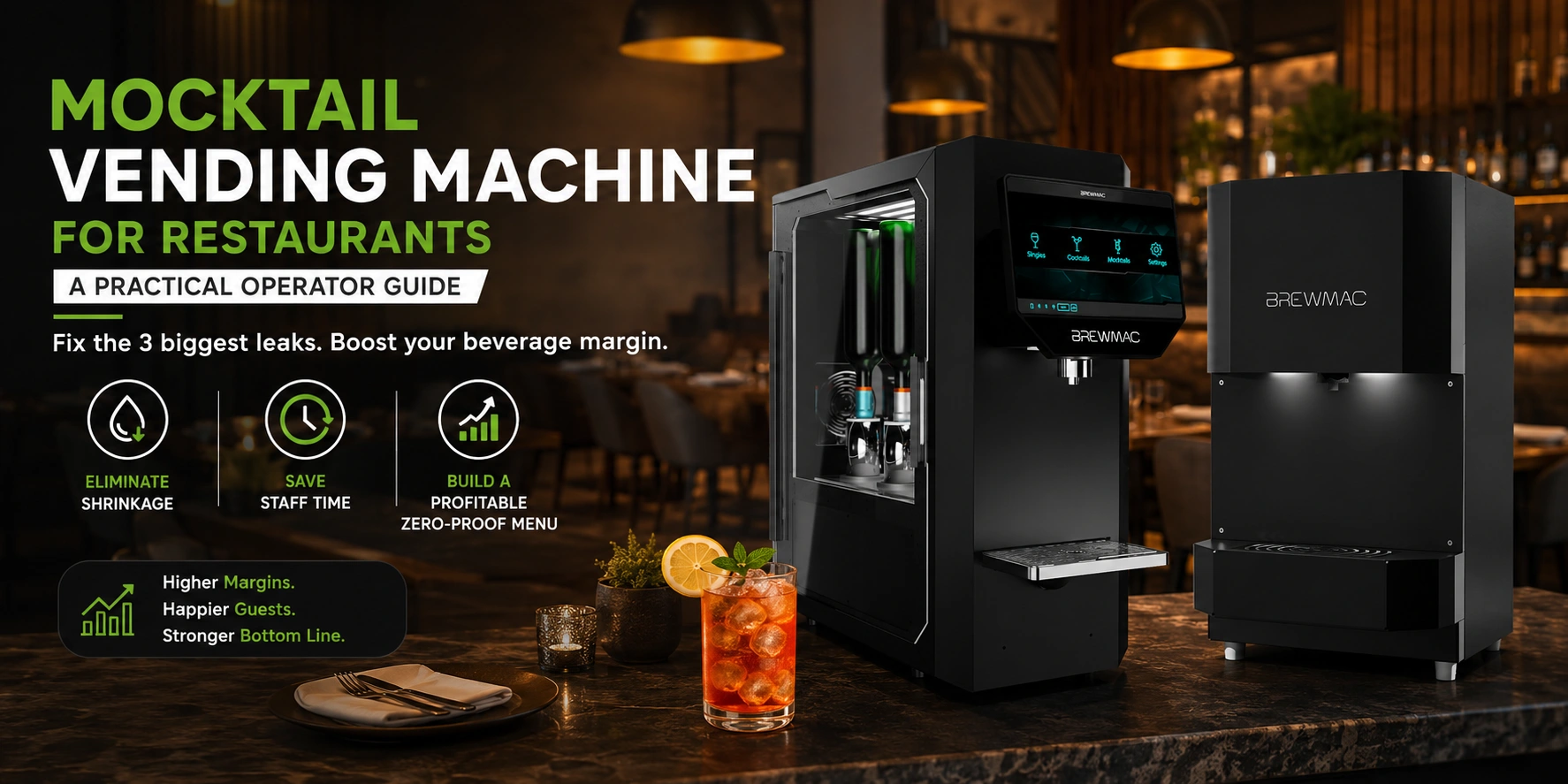
A restaurant’s beverage margin is where profitability lives — and it is where most operators lose the most money. A mocktail vending machine fixes the three biggest leaks at once: shrinkage, staff time, and a zero-proof menu that actually earns.
A mocktail vending machine for restaurants is not an add-on — it is a beverage revenue system that eliminates the operational failures that drain margin at every service. Shrinkage from over-pour. Server time diverted to drink preparation. A non-alcoholic menu that amounts to soda and juice at ₹60 a glass. All three are commercial problems. All three are solved by a single AI-precision mocktail machine placed correctly in the restaurant floor.
This guide is written for restaurant operators who already understand their beverage economics and want to know exactly what a mocktail vending machine changes — practically, operationally, and financially. No preamble. Just the numbers, the placement logic, and the honest assessment of which restaurant types benefit most.
The Seven Restaurant Beverage Problems a Mocktail Machine Solves
Every restaurant operator running a beverage service recognises these pain points. Here is how a mocktail vending machine addresses each one directly:
| Restaurant Pain Point | What Causes It | How the Machine Solves It |
| Beverage revenue lost to shrinkage | Over-pour, theft, manual measurement errors — up to 20% loss (Barmetrix) | Less than 2ml variance per pour — every ingredient measured automatically |
| Peak-hour beverage queue | Server bandwidth exhausted — table orders delayed | 700+ drinks/hour autonomous throughput — no server involvement |
| Inconsistent beverage quality | Different staff, different skills, fatigue over long shifts | Locked recipes — identical pour every time, every shift |
| Staffing cost for beverage service | Dedicated server or bartender time diverted to drink preparation | Machine operates autonomously — server focuses on food service and table care |
| No premium non-alcoholic option | Soda and juice are the only zero-proof alternatives — poor margin | 14 real-fruit premium mocktails at 62–75% gross margin |
| Beverage inventory management | Manual stock count — often inaccurate, frequently wasted | Real-time cloud tracking per pour — automatic low-stock alerts |
| FSSAI beverage compliance | Manual ingredient records — prone to gaps and audit exposure | Automatic cloud audit trail — every batch logged with RFID traceability |
Bars and venues lose up to 20% of their beverages to variance and shrinkage (Barmetrix). For a restaurant serving 200 guests per day across a lunch and dinner service, that 20% loss represents a measurable daily revenue drain. A machine that dispenses every ingredient to within 2ml eliminates the uncontrolled component of that loss completely.
The Labour Argument: Why Staff Time Is the Hidden Cost
India’s hospitality sector faces a 150,000-worker shortfall and 40% annual turnover in trained staff (Adevo, 2025). In a restaurant context, this creates a specific operational problem: every minute a server or bartender spends preparing a non-alcoholic drink is a minute not spent on table management, upselling, or guest care — the activities that drive the food bill.
A mocktail vending machine removes beverage preparation from the server’s task list entirely. Guests self-serve. The server’s attention stays at the table. For restaurants running lean on floor staff — which describes most Indian restaurants outside the top tier — this reallocation of staff time has a direct impact on table turn rate and average bill value.
The machine does not replace your staff. It gives them their time back — time they spend on the work that actually grows your revenue per cover.
The Non-Alcoholic Menu Argument: Why Soda Is No Longer Enough
The standard restaurant non-alcoholic menu in India — soda, packaged juice, lassi, and perhaps a masala chaas — prices out at ₹40–₹80 per item at a 30–40% gross margin. This is not a beverage category; it is a gap in the menu that experienced diners notice.
Zero-proof mocktail menus achieve margins up to 22% higher than traditional soft drinks (Technavio, 2026). A Virgin Mojito, Passion Fruit Cooler, or Aam Panna at ₹150 from an AI-precision machine carries a 62–75% gross margin and signals a premium beverage programme that a packaged juice does not. For restaurants positioning above the commodity tier, this signal matters to the right guests.
The health-conscious, sober-curious, and family-dining segments that drive India’s restaurant growth are all underserved by soda. A mocktail machine fills that gap with 14 real-fruit options — and at a margin that justifies the investment.
Which Type of Restaurant Benefits Most from a Mocktail Machine?
Not every restaurant format is equally well suited to a mocktail machine. Here is an honest assessment by restaurant type:
| Restaurant Type | Machine Fit | Recommended Model |
| Casual dining / family restaurant | High — families include non-drinking adults and children; mocktail demand strong | Pro |
| QSR / fast casual | High — high footfall, fast service, self-serve model fits naturally | Pro / Grand |
| Fine dining | Medium — mocktails as a premium non-alcoholic pairing; machine supplements sommelier | Pro (discreet placement) |
| Multi-cuisine restaurant | High — broad guest demographic, all-ages appeal of zero-proof menu | Pro / Grand |
| Dhaba / Indian cuisine | High — Indian-twist mocktails (Aam Panna, Jaljeera) fit the menu and guest profile | Pro |
| Cloud kitchen / delivery-only | Low — no dine-in footfall; machine requires on-site guest interaction | Not recommended |
| Food court stall | Very high — high footfall, self-serve expected, impulse purchase dominant | Grand |
| FINE DINING NOTE In a fine dining context, the mocktail machine is a supplement to the beverage programme — not the centrepiece. Position it discreetly as a self-serve option for guests who prefer not to interact with the sommelier for non-alcoholic choices. Price it at the premium end (₹180–₹250 per mocktail) and frame it as a zero-proof pairing option on the menu. The machine does not diminish the dining experience — it expands the non-alcoholic offering without reducing the sommelier’s focus on wine and spirits service. |
Where to Position a Mocktail Machine in Your Restaurant
Placement determines yield. A machine in the right position in a restaurant captures purchase decisions that a machine in the wrong position misses entirely.
| Placement Zone | Why It Works | Revenue Yield |
| Entry / waiting zone | Guests waiting for a table — dwell-time purchase before they are seated | High — captures spend before the table bill opens |
| Bar counter / service station | Adjacent to beverage service — servers can direct guests | High — integrates into existing beverage service flow |
| Self-service beverage zone | Standalone mocktail station — guests serve themselves between courses | Medium-high — works in casual dining and QSR formats |
| Takeaway / packaging counter | Guests collecting takeaway orders — last-minute beverage add-on | Medium — impulse purchase at collection point |
| Outdoor / terrace area | Al-fresco seating — wireless deployment without fixed installation | Medium — seasonal and weather-dependent |
For most restaurant formats, the entry or waiting zone is the highest-yield placement. Guests waiting for a table are in a passive, dwell-time state — they have time to browse a touchscreen and make a purchase decision. Once seated, a server’s attention redirects them to the menu. The machine at the entry captures the spend before the table bill competes for it.
How a Mocktail Machine Protects Beverage Margin
The three margin leaks in restaurant beverage service are over-pour, theft, and inconsistency. A mocktail machine eliminates all three:
- Over-pour eliminated — Every pour is recipe-locked to within 2ml. There is no manual measurement, no free-pour, no bartender estimating a 30ml ingredient by eye. The exact specified volume is dispensed every time.
- Theft risk reduced — Every transaction is logged to the cloud dashboard in real time. Every ingredient volume dispensed is recorded. There is no untracked inventory movement — the machine account matches the cloud record precisely.
- Consistency guaranteed — The same recipe every time means the same cost per drink every time. There are no surprise batch costs from a bartender who ‘improved’ the recipe by adding an extra splash. The margin is predictable because the pour is locked.
For the full breakdown of pricing models — rental, revenue share, and franchise — and what the commercial arrangement looks like for a restaurant operator, see the mocktail vending machine price guide for India.
How the Restaurant Deployment Differs from a Café
The mocktail machine mechanics are identical across café and restaurant deployments — same machine, same cloud system, same 14-drink menu. The differences are operational context, placement logic, and guest journey. The mocktail machine for cafes guide covers the café-specific ROI and menu strategy in detail. For restaurants, the key differences are:
- Guest journey — Restaurant guests typically arrive, wait, are seated, and then order. The machine captures the waiting-zone spend and the self-serve between-course spend — not primarily the at-counter impulse purchase that dominates in a café.
- Pricing — Restaurant guests expect and accept higher beverage pricing than café guests. ₹150–₹200 per mocktail is appropriate for a mid-tier restaurant; ₹180–₹250 is viable for premium and fine dining positioning.
- Volume — Restaurants typically generate beverage volume across two defined service windows — lunch and dinner — rather than the continuous all-day traffic of a café. The machine’s throughput more than handles both windows without queue formation.
- Staff interaction — In a restaurant, the server is the primary guest touchpoint. The machine is positioned as a self-serve complement to the server’s table management — not a replacement for the server’s role. Briefing front-of-house staff to mention the machine during seating is the highest-yield promotional action a restaurant operator can take.
Frequently Asked Questions
Is a mocktail vending machine suitable for a restaurant?
Yes — particularly for casual dining, QSR, multi-cuisine, family dining, and food court formats. The machine adds a premium non-alcoholic beverage category without additional staff, protects beverage margin through precision dispensing, and works as a self-serve option for guests who prefer not to wait for server-mediated drink orders.
What is the margin on a mocktail machine in a restaurant?
At a restaurant selling price of ₹150–₹200 per mocktail and a per-drink ingredient cost of ₹30–₹45, gross margin runs at 62–75%. This is significantly above the gross margin on packaged juice or soda — and zero-proof mocktail menus achieve margins up to 22% higher than traditional soft drinks overall (Technavio, 2026).
Does the machine require a dedicated server or bartender?
No. The RollingFizz machine operates fully autonomously — guests self-serve via the touchscreen, pay via UPI or NFC, and receive their mocktail without any staff involvement in the dispensing process. The operator’s only daily task is a 10–15 minute surface clean and ingredient stock check via the cloud dashboard. All technical maintenance is managed by the RollingFizz service team.
Can the restaurant set its own mocktail prices?
Yes. The machine’s touchscreen can display the restaurant’s own retail prices — set by the operator, not fixed by RollingFizz. The ingredient cost per drink is determined by the RollingFizz recipe and supply arrangement. The margin between ingredient cost and retail price is the operator’s commercial outcome. RollingFizz recommends pricing at the premium end of the local market to maximise per-drink margin and signal quality positioning.
How does the machine handle peak service periods in a restaurant?
The RollingFizz Pro model handles mid-to-high commercial volume comfortably within a restaurant peak service window. For food courts or very high-footfall restaurant formats, the Grand model provides 700+ drinks per hour throughput. The machine does not slow down or degrade during peak periods — throughput is consistent regardless of how many drinks have been served in the preceding hour.
See what a mocktail machine does to your restaurant’s beverage margin.
Book a free RollingFizz demo and see the full system in a restaurant context — machine footprint, pour speed, cloud revenue tracking, and the economics of replacing soda with premium real-fruit mocktails at 62–75% gross margin.

Leave a Reply
You must be logged in to post a comment.