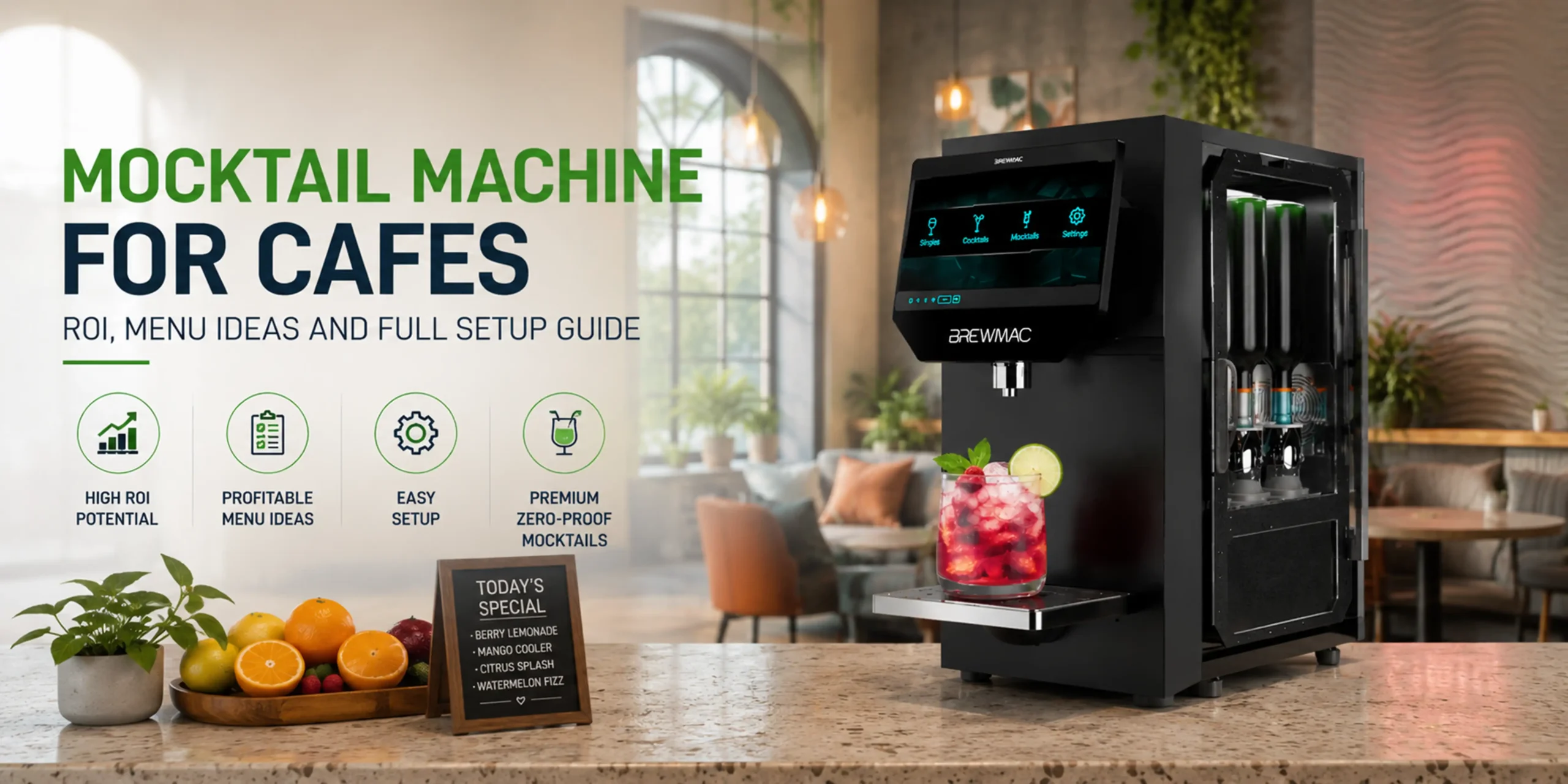
The café down the street serves coffee and desserts. Yours serves 14 real-fruit mocktails — poured in 30 seconds, no extra staff, with margins that rival your best-selling beverage. That is what a mocktail machine adds to a café.
A cocktail machine for cafes is one of the highest-return equipment investments an Indian café operator can make right now. It adds an entirely new beverage category — premium, zero-proof, real-fruit mocktails — without adding staff, without a bar licence, and without the infrastructure of a full beverage counter. The machine sits on or near your counter, serves itself, and logs every sale to a cloud dashboard in real time.
This guide answers every question a café owner needs answered before committing: what the ROI looks like, which mocktails work best on a café menu, where to position the machine, and exactly what to set up before day one. If you are still evaluating whether a mocktail vending machine is right for your venue type, start with the foundational overview before reading this.
The Three Questions Every Café Owner Asks First
Before any café operator commits to a mocktail machine, three questions come first. Here are the direct answers.
Will it actually sell in a café setting?
Yes — and faster than most operators expect. India’s non-alcoholic beverage market is valued at USD 80.11 billion in 2025, growing at 6.80% CAGR (Expert Market Research). Zero-proof mocktail menus are the fastest-growing beverage segment in Indian hospitality settings. A café counter machine captures impulse purchases from guests who would otherwise order a standard cold coffee or juice — at a higher margin per drink.
How much space does it take?
The RollingFizz Pro model — the recommended unit for café deployment — has a compact counter footprint. It does not require a separate bar counter, plumbing, or specialist installation infrastructure. A standard power outlet and WiFi connection are the full setup requirements. See the complete placement and connectivity guidance in the full installation checklist at the end of this article.
What is the margin?
Zero-proof mocktail menus achieve margins up to 22% higher than traditional soft drinks (Technavio, 2026). At a café selling price of ₹120–₹180 per mocktail against a per-drink ingredient cost of ₹30–₹45, the gross margin per drink runs at 62–75%. The ROI table below breaks this down in full.
Mocktail Machine ROI for Cafes: The Full Breakdown
Here are the economics of a RollingFizz Pro installed in a mid-size Indian café. All figures use conservative daily volume estimates:
| Metric | Figure | Note |
| Average drinks served per day (café) | 80–120 drinks/day | Conservative estimate for a mid-size café |
| Average selling price per mocktail | ₹120–₹180 | Premium positioning — real-fruit, branded |
| Daily revenue (mid estimate) | ₹12,000–₹18,000 | 100 drinks × ₹120–₹180 |
| Monthly revenue (26 trading days) | ₹3,12,000–₹4,68,000 | Based on daily mid estimate |
| Ingredient cost per drink | ₹30–₹45 | Real-fruit syrup + carbonation per pour |
| Gross margin per drink | ₹75–₹135 | Selling price minus ingredient cost |
| Gross margin percentage | 62–75% | Consistent with NoLo premium margins (Technavio) |
| Monthly rental cost (RollingFizz Pro) | Contact RollingFizz for current pricing | Starting from rental — zero upfront capital |
| Staffing cost eliminated | 1 part-time barista equivalent | Machine operates autonomously — no dedicated staff |
| USING ‘STARTING FROM’ LANGUAGE RollingFizz rental and revenue-share pricing varies by model, location, and commercial arrangement. The figures above use indicative selling prices based on Indian café market positioning — ₹120–₹180 per mocktail. Contact RollingFizz for current pricing on the Pro model and to confirm which commercial format — rental, revenue share, or franchise — fits your café’s business model. |
Mocktail Menu Ideas for Cafes: What to Feature and How to Price It
The RollingFizz machine serves multiple fixed real-fruit mocktails. For café operators, the question is not which drinks are available — it is how to present them on your menu board and which to feature prominently for maximum sales velocity.
| Menu Category | Recommended Mocktails | Commercial Note |
| All-day staples | Virgin Mojito, Lemon Soda, Ginger Lemon | High repeat purchase — morning through evening |
| Indian signatures | Aam Panna, Jaljeera, Kala Khatta | Strong recognition — drives impulse purchase from familiar flavours |
| Premium upsells | Passion Fruit Cooler, Watermelon Fizz, Cucumber Mint | Higher price point — differentiates from standard café offerings |
| Festive specials | Rose Sharbat, Mango Lassi Fizz, Tamarind Twist | Seasonal demand — Diwali, Eid, summer — updated via cloud |
| Wellness positioning | Ginger Lemon, Cucumber Mint, Aam Panna | Health-conscious guests — gym-adjacent or corporate café positioning |
The strongest café menu strategy is to feature three to four signature mocktails prominently — one Indian classic, one international zero-proof, and one seasonal — and let the touchscreen do the rest. Customers who approach the machine discover the full 14-drink menu themselves.
Price the mocktails at a premium. Real-fruit ingredients and AI precision dispensing justify ₹150–₹180 per drink in an Indian café context. Pricing below ₹120 undervalues the product and signals commodity positioning.
Where to Position a Mocktail Machine in Your Café
Placement is the single most important operational decision after choosing the machine. A correctly placed machine generates significantly more revenue than an identically specified machine in the wrong position.
Counter placement — primary recommendation
Position the machine at or near the billing counter — the highest-traffic point in every café. Guests waiting to order or pay are in decision mode. A machine visible at eye level at this point captures impulse purchases that a machine tucked in a corner never sees.
Waiting area placement — secondary option
For cafés with a distinct waiting zone or lounge seating area, a machine positioned here captures the dwell-time purchase — guests who have already ordered food and are looking for a beverage to accompany the wait. This placement works alongside a counter-positioned machine, not instead of it.
Street-facing or window placement — visibility play
For cafés with street-facing frontage, a machine visible through the window or at the entry creates an external impulse signal — passers-by see the machine and are drawn in. This placement is particularly effective for high-footfall street-level locations in Indian urban markets.
For the full wireless connectivity and placement guide — including signal confirmation checklist and venue-by-venue positioning strategy — see the wireless mocktail machine placement guide.
Café Setup Checklist: What to Confirm Before Your Machine Goes Live
Use this checklist to confirm every setup item before the RollingFizz installation team arrives:
| Setup Item | Detail |
| Placement point confirmed | Counter near till, waiting area, or customer-facing position — maximum sightline from guest entry |
| Power outlet verified | Standard 5-amp socket within cable reach of placement point |
| WiFi signal confirmed | Strong signal at exact placement point — not just in general café area |
| SIM backup arranged | Recommended for continuous cloud management — contact RollingFizz for SIM options |
| Menu pricing set | Decide retail price per mocktail — ₹120–₹180 recommended for café premium positioning |
| Staff briefed | Front-of-house team knows the machine is self-service — redirect guests who ask for help |
| Cloud dashboard access confirmed | Operator has app installed and cloud account activated before launch day |
| FSSAI compliance checked | 14-digit FSSAI number displayed at the machine or point of service — confirm licence coverage |
| Promotional material ready | Table cards, social media post, menu board update — announce the machine to existing customers |
Which Commercial Format Is Right for Your Café?
RollingFizz offers three commercial formats for café operators. The right choice depends on your café’s size, trading volume, and expansion plans.
- Monthly rental — Fixed monthly fee covering the machine, software, and maintenance. Best for cafés that want a predictable cost structure with zero capital outlay. Machine, cloud, and service included.
- Revenue share — Zero upfront investment. RollingFizz earns a percentage of revenue per drink sold. Best for high-footfall cafés with strong daily volume — the more the machine sells, the more both parties earn.
- Franchise / purchase — Own the machine and operate it as part of the RollingFizz franchise network. Highest long-term return for operators planning to scale to multiple locations or build a standalone mocktail business.
For a full breakdown of pricing across all commercial formats and RollingFizz models, see the mocktail vending machine price guide for India.
Frequently Asked Questions
Is a mocktail machine worth it for a small café?
Yes — provided daily footfall is sufficient to support the volume. A café serving 50+ guests per day has the traffic to generate meaningful mocktail machine revenue. At 80 drinks per day at ₹150 average, monthly gross revenue from the machine alone is approximately ₹3,12,000. Even at 40 drinks per day, the machine generates a meaningful new revenue stream without adding staff or kitchen capacity.
Does a café need a bar licence to operate a mocktail machine?
No. RollingFizz machines serve exclusively non-alcoholic, zero-proof mocktails. State Excise licensing does not apply. The primary regulatory requirement is a FSSAI Food Licence — which most operating cafés already hold. A café with an existing FSSAI licence can deploy a RollingFizz machine without any additional licensing in most states. RollingFizz provides full compliance guidance as part of every café arrangement.
How many mocktails can a café machine serve per hour?
The RollingFizz Pro model — recommended for café deployment — handles mid-volume commercial throughput comfortably. For a café environment where the machine is one of several beverage options rather than the primary service point, the Pro’s throughput exceeds café demand at any realistic peak-hour scenario. The Grand model is available for very high-footfall café or food-court settings.
Can the café customise the mocktail menu?
The RollingFizz recipe library is centrally managed — the 14 real-fruit mocktails are locked and maintained by RollingFizz. Seasonal additions are deployed via cloud update. The café operator does not configure individual recipes. This is a deliberate design choice: recipe locking guarantees the same quality and consistency that justifies premium pricing — something a manually configured machine cannot reliably maintain.
What happens if the machine runs out of an ingredient during trading hours?
The RollingFizz cloud dashboard sends an automatic low-stock alert to the operator’s phone before any ingredient runs out — typically when stock reaches the 20% threshold. The operator restocks the relevant syrup cartridge before depletion. In the event of an unexpected stockout, the machine removes that drink from the active menu on the touchscreen — guests see only available drinks and the machine continues serving all other mocktails uninterrupted.
Add a mocktail machine to your café — see the ROI live.
Book a free RollingFizz demo and see exactly what the machine looks like in a café setting — the counter footprint, the touchscreen menu, the pour speed, and the cloud dashboard that shows you revenue in real time.

Leave a Reply
You must be logged in to post a comment.