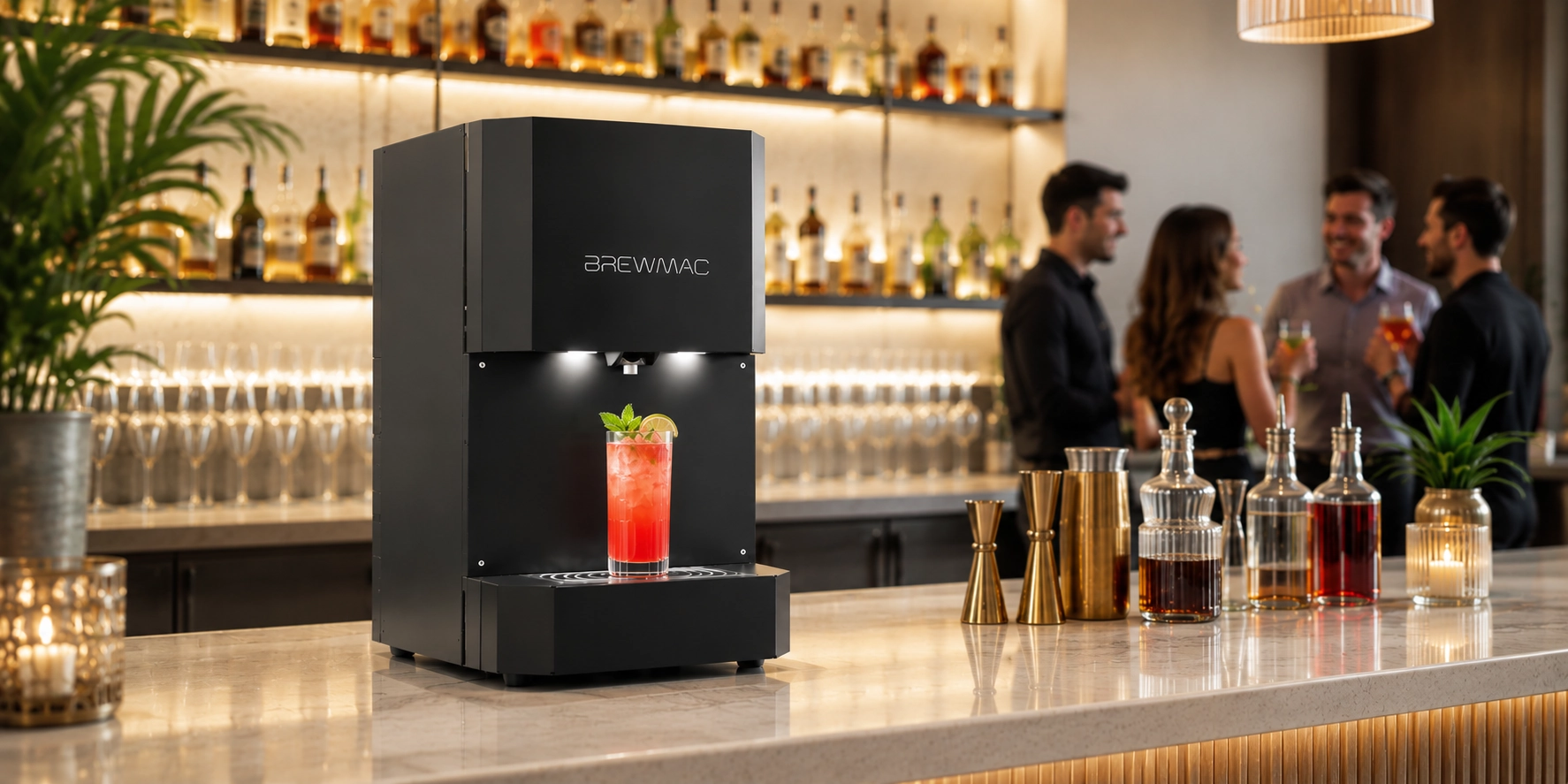
Every bar has guests who are not drinking tonight. The designated driver. The sober-curious regular. The non-drinker in the group who wants something worth holding. A cocktail station for bars stops turning those guests into a soda-and-lime problem and starts turning them into a revenue line.
A cocktail station for bars is a dedicated zero-proof beverage point — an automated mocktail machine positioned alongside the main bar that serves the guests your bar currently underserves. Not instead of the bar. Not as a replacement for the bartender. Alongside both — as the premium non-alcoholic answer your bar does not currently have.
India’s bar, pub, and lounge market stood at USD 2.8–3.07 billion in 2024 and is growing at 7–7.4% CAGR (IMARC / TechSci). Every bar in that market has guests who are not drinking alcohol on a given night. Every one of those guests currently receives a soda or a juice. A RollingFizz mocktail vending machine at your bar gives those guests 14 real-fruit zero-proof drinks worth ₹180–₹280 per glass — and gives you a revenue stream you are currently leaving on the table.
Who Is the Sober-Curious Guest and Why Does Your Bar Need to Serve Them?
The sober-curious guest is not a niche demographic — it is a growing segment of every bar’s existing customer base. They include designated drivers who arrive with a group and stay for hours. Guests in dry months — Navratri, dry days, personal health decisions — who come out socially but do not drink. Non-drinking friends within drinking groups who currently order soda because there is nothing better available. Health-conscious regulars who want a premium evening experience without alcohol.
RTD non-alcoholic formats are the fastest-growing beverage segment in Indian event and hospitality settings (Expert Market Research, 2025). The demand is already in your bar — it is just currently being met with a ₹80 soda that takes five seconds to pour and generates no loyalty, no conversation, and no reason for the guest to return.
- The designated driver — Arrives with a group of four. Stays for three hours. Currently drinks three sodas at ₹80 each. With a mocktail station: three real-fruit mocktails at ₹220 each. Revenue difference: ₹240 vs ₹660 — from the same guest, the same visit.
- The sober-curious regular — Visits your bar regularly but reduces or eliminates alcohol for personal or health reasons. A premium mocktail menu keeps them coming. A soda menu sends them to a café instead.
- The non-drinker in the group — Every group of four to six includes at least one non-drinker. Their drink decision shapes the group’s venue choice more than any other factor — they are the group’s veto vote on where to go.
- The dry-month guest — Navratri, dry days, Ramadan, personal challenges — India has a significant and growing cohort of guests who reduce alcohol consumption for defined periods. A premium mocktail station keeps them in your venue during those periods.
The Margin Argument: Why Mocktails Outperform Soda in a Bar Context
The financial case for a mocktail station in a bar is not about replacing alcohol revenue — it is about upgrading the revenue per non-drinking guest from a ₹80 soda to a ₹220 real-fruit mocktail. Here is the full margin comparison:
| Beverage Category | Typical Selling Price (Bar) | Ingredient Cost | Gross Margin % | Notes |
| Standard soda / juice | ₹80–₹120 | ₹25–₹40 | 50–65% | Low perceived value — difficult to justify premium pricing |
| House spirit cocktail | ₹300–₹500 | ₹80–₹140 | 65–75% | High margin but requires bartender and excise licence |
| Premium imported cocktail | ₹600–₹900 | ₹180–₹280 | 65–70% | High revenue but high ingredient cost and staff dependency |
| RollingFizz real-fruit mocktail | ₹180–₹280 | ₹30–₹50 | 72–82% | Highest margin per drink — no excise licence, no bartender |
The RollingFizz real-fruit mocktail achieves the highest gross margin of any beverage category on this table — and requires no bartender, no excise licence, and no additional staff. Zero-proof mocktail menus achieve margins up to 22% higher than traditional soft drinks (Technavio, 2026). In a bar context where the ingredient cost of a premium mocktail runs at ₹30–₹50 and the selling price reaches ₹220–₹280, the gross margin percentage is the strongest in the venue.
The mocktail station does not compete with your bar. It monetises the guests your bar was never serving in the first place.
Which Bar and Lounge Types Benefit Most from a Mocktail Station?
The sober-curious opportunity exists across every bar format — but the commercial argument is strongest in specific venue types. Here is the full breakdown:
| Bar / Lounge Type | Sober-Curious Demand | Machine Role | Recommended Placement |
| Cocktail bar | High — designated driver guests, sober-curious regulars, non-drinking group members | Standalone mocktail station alongside main bar | Adjacent to main bar — same service zone |
| Rooftop bar / lounge | High — mixed groups, health-conscious evening crowd | Premium mocktail alternative to alcohol | Near entrance or secondary service point |
| Nightclub / dance venue | Medium — guests who want to dance without drinking; peak hour throughput critical | High-volume mocktail station — Grand model | Entry level or secondary bar counter |
| Hotel bar / executive lounge | High — business travellers, dry-month guests, international visitors | Complement to main bar programme | Lounge seating area or secondary counter |
| Sports bar | Medium — designated drivers, family sections | Self-serve between rounds | Near seating section or family zone |
| Wine bar / taproom | Medium — guests exploring low-ABV or zero-proof options | Zero-proof premium alternative | Bar counter — companion to wine service |
| Beach bar / resort bar | High — health-conscious daytime guests, non-drinkers in groups | All-day mocktail service alongside bar | Pool or beach-adjacent position |
| POSITIONING PRINCIPLE The mocktail station in a bar or lounge should never be positioned as the ‘non-drinker corner.’ It should be positioned as the premium craft beverage station — a zero-proof programme that has its own identity, its own pricing, and its own guest experience. Guests who choose the mocktail station should feel they are upgrading their experience, not settling for the alcohol-free option. |
How a Mocktail Machine Works Alongside Your Existing Bar
It does not replace the bartender
The RollingFizz mocktail station operates autonomously — guests self-serve via the touchscreen, pay via UPI or NFC, and receive their drink in under 30 seconds. The bartender’s workflow is completely undisturbed. The machine handles its own orders, its own payment, and its own revenue tracking. The bartender focuses entirely on alcohol-based service.
It expands the beverage programme without expanding the team
Adding a craft mocktail programme to a bar’s menu without a machine requires additional bartender time, additional training, and additional ingredient management. The machine adds 14 premium mocktails to the venue’s beverage offering without any of those operational costs. The programme launches the day the machine is installed.
It serves peak hours without degrading
A bar at peak service on a Friday night has its bartender team fully stretched on alcohol orders. The mocktail station serves non-alcoholic guests simultaneously — 700+ drinks per hour on the Grand model — without competing for the bartender’s attention or creating a separate service queue. Peak hour performance is identical to off-peak hour performance.
Cloud dashboard — separate revenue tracking
The RollingFizz cloud dashboard tracks mocktail machine revenue separately from the bar’s main POS — giving the operator a clear view of the zero-proof revenue stream in isolation. The operator can see which mocktails sell best, at which times, and on which nights — data that informs menu decisions and promotional strategy.
Licensing: What a Bar Needs to Know Before Adding a Mocktail Station
This is the most common compliance question bar operators ask. The answer is clear:
- State Excise licence — Does NOT apply to RollingFizz. The machine serves exclusively non-alcoholic mocktails. No excise licence is required for the mocktail station, regardless of whether the bar itself holds an excise licence for alcohol service.
- FSSAI Food Licence — The bar’s existing FSSAI licence covers non-alcoholic beverage service at the premises. No additional FSSAI licence is required for the RollingFizz machine in most configurations. RollingFizz provides full compliance documentation at installation.
- GST — Non-alcoholic beverages are subject to GST at the applicable rate for the beverage category. RollingFizz’s cloud system logs all transactions with the information required for GST reporting.
| IMPORTANT — EXCISE CLARITY A bar holding a State Excise licence for alcohol service (L-10, P-10, P-13 or equivalent) does not require any additional excise licence to operate a RollingFizz mocktail station. The mocktail machine is a non-alcoholic food product dispenser — regulated under FSSAI, not under State Excise. The two licensing regimes operate independently. RollingFizz is not subject to excise regulation in any state. |
Frequently Asked Questions
Can a bar add a mocktail machine without an excise licence?
Yes. RollingFizz machines serve exclusively non-alcoholic, zero-proof mocktails — State Excise licensing does not apply. A bar that already holds an excise licence for alcohol service does not require any additional licensing to operate a RollingFizz mocktail station. The bar’s existing FSSAI Food Licence covers non-alcoholic beverage service.
Will a mocktail machine compete with the bar’s alcohol revenue?
No. A mocktail station serves guests who are not ordering alcohol — it does not pull drinks away from the bar’s alcohol revenue. The designated driver, the sober-curious guest, and the non-drinker in the group are currently generating ₹80 per visit at your bar. The mocktail station upgrades their spend to ₹220+ without affecting alcohol orders from drinking guests.
Which RollingFizz model is best for a bar or lounge?
For most bar and lounge deployments, the Pro model is the correct choice — mid-volume commercial throughput, compact counter footprint, and full cloud management. For high-footfall nightclubs, large rooftop bars, or venues serving 500+ guests per night, the Grand model provides 700+ drinks per hour throughput. The RollingFizz team will advise on model selection based on your venue’s capacity and peak-hour volume.
How does the mocktail machine handle pricing in a bar context?
The bar operator sets the retail price displayed on the machine’s touchscreen. RollingFizz recommends ₹180–₹280 per mocktail for a bar or lounge context — reflecting the premium positioning of a real-fruit, AI-precision crafted drink in a licensed venue. This pricing is set and can be adjusted by the operator via the cloud dashboard without any technician visit.
For the full breakdown of commercial formats — rental, revenue share, and franchise — and pricing across all RollingFizz models, see the mocktail vending machine price guide for India. For how the machine operates in hotel bar and lounge contexts specifically, see the automated bar machine for hotels guide.
Add a mocktail station to your bar. Serve every guest.
Book a free RollingFizz demo and see how a mocktail station integrates into a bar environment — the counter footprint, the pour experience, and the cloud revenue tracking that shows your zero-proof revenue stream in real time alongside your main bar.

Leave a Reply
You must be logged in to post a comment.