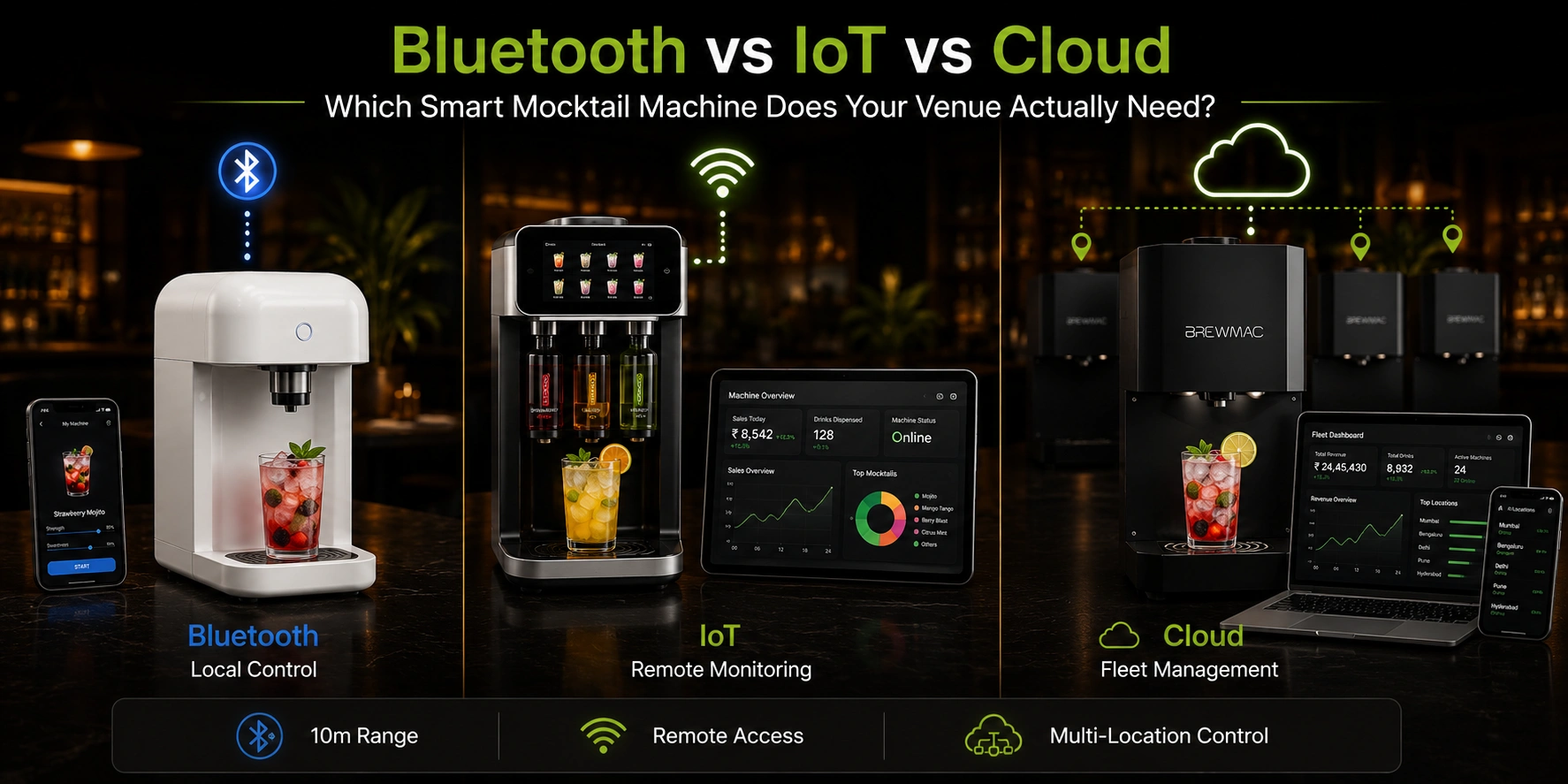
Bluetooth, IoT, cloud — three connectivity types, three very different commercial realities. The wrong choice costs you visibility, control, and revenue. Here is how to choose correctly.
If you are evaluating a Bluetooth cocktail machine, an IoT-connected mocktail dispenser, or a cloud-managed beverage system for your venue — the terminology matters. Each connectivity type delivers a fundamentally different level of operational control. Choosing the wrong one for your venue size or business model means paying for capability you cannot use, or missing the management features you actually need.
This guide compares all three side by side — Bluetooth, IoT, and cloud — so you can match the right connectivity model to your venue, your volume, and your operational priorities. For a broader overview of what a mocktail vending machine is, start with the foundational guide before reading this comparison.
Bluetooth, IoT and Cloud: What Each Term Actually Means
Bluetooth cocktail machine
A Bluetooth cocktail machine connects to a smartphone or tablet within short range — typically 10 metres — via Bluetooth. The operator controls the machine through a dedicated app: selecting recipes, adjusting settings, or viewing basic usage data. Bluetooth connectivity requires the controlling device to be physically near the machine. It provides no remote access, no cloud dashboard, and no fleet management capability.
Bluetooth machines are suited to home use or very small personal setups where the operator is always present. For any commercial venue deployment, Bluetooth connectivity alone is insufficient.
IoT mocktail machine
An IoT mocktail machine connects to the internet via WiFi or a mobile SIM card. This gives the operator remote access — they can view stock levels, transaction data, and machine status from anywhere with an internet connection. IoT machines send real-time data to a cloud server and can receive remote updates and alerts.
IoT connectivity is appropriate for a single commercial venue — one machine, one location, managed remotely by the operator. It is a significant upgrade over Bluetooth, but still limited when managing multiple units across multiple locations.
Cloud-managed mocktail machine fleet
A cloud-managed system takes IoT connectivity and adds a centralised management platform — a fleet dashboard that aggregates data from multiple machines across multiple locations into one unified view. Operators see live revenue, stock levels, pour performance, and machine health for every unit simultaneously. Recipe updates, pricing changes, and software upgrades deploy across the entire fleet from one action.
Cloud management is the correct architecture for any operator running more than one machine — franchise investors, multi-location venue groups, and commercial operators planning to scale. This is the RollingFizz operating model.
Bluetooth vs IoT vs Cloud: The Full Comparison
Every factor a venue operator or franchise investor needs to evaluate — side by side across all three connectivity types:
| Factor | Bluetooth Cocktail Machine | IoT Machine (WiFi/SIM) | Cloud-Managed Fleet (RollingFizz) |
| Connection type | Bluetooth (10m range) | WiFi or mobile SIM | WiFi/SIM + cloud platform |
| Remote access range | In-range device only | Anywhere with internet | Anywhere — full fleet view |
| Real-time stock alerts | No | Yes — single unit | Yes — all units simultaneously |
| Revenue tracking | Manual or app-based (limited) | Per-unit, real-time | Per-unit + consolidated fleet P&L |
| Software updates | Manual via Bluetooth app | Remote — single unit | Remote — entire fleet at once |
| Recipe management | App-controlled (if supported) | Remote update — single unit | Centralised — deploy to all units |
| Maintenance alerts | None | Single-unit alerts | Fleet-wide predictive alerts |
| Multi-location management | Not possible | Possible — one app per unit | One dashboard — all units, one screen |
| Payment integration | App-based QR or manual | UPI, NFC, contactless | UPI, NFC, contactless — all units |
| FSSAI audit trail | None | Transaction log — single unit | Full audit trail — all units, all time |
| Best suited for | Home use, personal setups | Single commercial venue | Multi-location venues and franchise fleets |
| RollingFizz model | Classic (home) | Pro / Trolley | Pro / Grand / Fleet franchise |
Why a Bluetooth Cocktail Machine Falls Short for Commercial Venues
Bluetooth connectivity was designed for consumer electronics — short-range, device-to-device pairing for personal use. Applied to a commercial mocktail machine in a café, restaurant, hotel, or event setting, it creates three operational problems that cannot be worked around:
- No remote management — The operator must be within Bluetooth range (10 metres) to control the machine. If you are not physically present at the venue, you have no visibility of stock levels, revenue, or machine status.
- No automatic alerts — A Bluetooth machine cannot push a low-stock alert to your phone when you are away from the venue. A stockout happens and you find out when a guest complains — not before.
- No fleet capability — Managing two or more Bluetooth machines means physically visiting each one to check status. There is no centralised view. Multi-location management via Bluetooth is not operationally viable.
For home use or a single personal setup where the operator is always present — a Bluetooth machine works. For any commercial deployment, IoT or cloud management is the minimum viable connectivity standard.
What IoT Connectivity Gets Right — and Where It Has Limits
IoT connectivity solves the core problems of Bluetooth for single-venue commercial operators. Remote access, real-time stock alerts, transaction logging, and predictive maintenance are all possible with a standard IoT machine connected via WiFi or SIM.
The limitation appears when the operator wants to scale. Managing five IoT machines across five venues means five separate dashboards, five separate alert streams, and five sets of revenue data — with no consolidated view and no fleet-level management capability. Each unit exists as an isolated data island.
For an operator running a single venue with a single machine — IoT is perfectly adequate. The moment a second unit is added, the case for cloud-managed fleet architecture becomes compelling.
Why Cloud Management Is the Right Choice for Commercial Venues
Cloud management is what transforms a mocktail machine from a beverage appliance into a managed revenue system. The difference is not just about connectivity — it is about what you can do with the data.
- One screen — all units — Every machine in the RollingFizz network is visible on one dashboard. Revenue, stock, performance, and health — per unit and consolidated — in real time.
- Fleet-level recipe management — Add a new seasonal mocktail to the menu and it deploys across every machine simultaneously. No site visits. No individual machine updates.
- Consolidated revenue reporting — Daily, weekly, and monthly revenue across the entire fleet — broken down by unit, location, drink type, and time of day. The data you need for investment decisions, franchise performance reviews, and expansion planning.
- Predictive maintenance across the fleet — The cloud system monitors every unit simultaneously. A calibration drift or carbonation pressure drop on any machine triggers an automatic alert — to the operator and the RollingFizz service team — before it affects trading.
Zero-proof mocktail menus achieve margins up to 22% higher than traditional soft drinks (Technavio, 2026). India’s non-alcoholic beverage market is valued at USD 80.11 billion in 2025, growing at 6.80% CAGR (Expert Market Research). The market opportunity is clear — and cloud management is the operational infrastructure that allows you to capture it at scale.
The full breakdown of how the RollingFizz IoT and cloud system works is covered in the IoT mocktail machine guide.
Which Connectivity Type Is Right for Your Situation?
Choose Bluetooth if:
- You are setting up a home bar or personal entertainment space
- You will always be present at the machine during operation
- Volume is very low — personal use only, not commercial service
- You are using the RollingFizz Classic for home use
Choose IoT (WiFi/SIM) if:
- You are operating a single commercial venue — one machine, one location
- Remote stock monitoring and transaction logging matter to your operations
- You want predictive maintenance alerts without managing a fleet
- You are starting with one unit and evaluating before expanding
Choose cloud management if:
- You are a franchise investor or multi-location venue operator
- You plan to deploy two or more machines across different sites
- Consolidated revenue data, fleet-level recipe management, and centralised maintenance coordination matter to your business model
- You are building a beverage business that needs to scale
Frequently Asked Questions
What is a Bluetooth cocktail machine?
A Bluetooth cocktail machine is an automated beverage dispenser that connects to a smartphone or tablet via Bluetooth for local control — typically within 10 metres. The operator uses a dedicated app to manage recipes and view basic usage data. Bluetooth machines are suited to home or personal use and are not recommended for commercial venue deployment where remote management and real-time monitoring are required.
Is Bluetooth or IoT better for a commercial mocktail machine?
IoT is significantly better for commercial deployment. A Bluetooth machine requires physical proximity to operate and provides no remote management, no automatic alerts, and no fleet capability. An IoT machine connects via WiFi or SIM — giving remote access, real-time stock alerts, predictive maintenance, and transaction logging from anywhere. For any commercial venue, IoT is the minimum viable connectivity standard.
What is the range of a Bluetooth cocktail machine?
Standard Bluetooth connectivity ranges from 10 to 30 metres depending on the Bluetooth version and physical obstructions. In a commercial venue environment — with walls, other electronic devices, and competing signals — effective range is often closer to 10 metres. This range limitation is the primary reason Bluetooth is unsuitable for commercial venue management, where the operator needs to monitor and manage the machine remotely.
Can a RollingFizz machine work without WiFi?
Core dispensing functions can continue for a limited period without WiFi connectivity. However, the cloud management features — real-time stock monitoring, automatic alerts, transaction logging, remote recipe management, and fleet visibility — require an active internet connection. RollingFizz recommends a dedicated WiFi connection with a mobile SIM backup at every commercial installation point to ensure continuous cloud connectivity.
Do I need cloud management for a single venue?
For a single venue with one machine, IoT connectivity via WiFi is sufficient for most operational needs — remote monitoring, stock alerts, transaction logging, and maintenance alerts. Cloud fleet management adds value when you operate two or more machines or want consolidated revenue reporting across multiple locations. If you plan to scale, starting with a cloud-capable machine from the outset avoids a connectivity upgrade later.
For pricing across all four RollingFizz models and the three commercial formats — rental, revenue share, and franchise — see the mocktail vending machine price guide for India.
See the cloud dashboard before you decide.
The RollingFizz demo covers both the machine experience and the cloud management platform — so you can evaluate the full system, not just the hardware. Book a free demo and see exactly what real-time fleet management looks like for your venue or franchise plan.

Leave a Reply
You must be logged in to post a comment.